Ergonomic assessment methods: a complete guide to choosing and applying each technique
Three out of five workers in the European Union report muscle and joint pain, according to the European Agency for Safety and Health at Work (EU-OSHA, 2019). Ergonomic risks are therefore the most common risks at work. They are also the worst measured, because firms keep picking the wrong option among the ergonomic assessment methods available.
This guide brings together the main ergonomic assessment methods used in the field. It explains what each one measures. It also offers a very simple rule for choosing: first define the risk factor, then pick the method.
What ergonomic assessment is and what it is for
Ergonomic assessment is the technical process that measures the risk of muscle and joint injury (MSD) in a task. That risk can come from awkward postures, from the weight a worker lifts, from repeated movements or from the design of the work area. Once the figure is on the table, the company decides which measures to apply and in which order.
This matters for two reasons. First, MSDs are the top work related disease on record in Spain, France and Italy (EU-OSHA, 2019). Second, a weak assessment leads to measures that do not work. If the method misses the factor that causes the harm, the budget goes nowhere.
The most common mistake when choosing ergonomic assessment methods
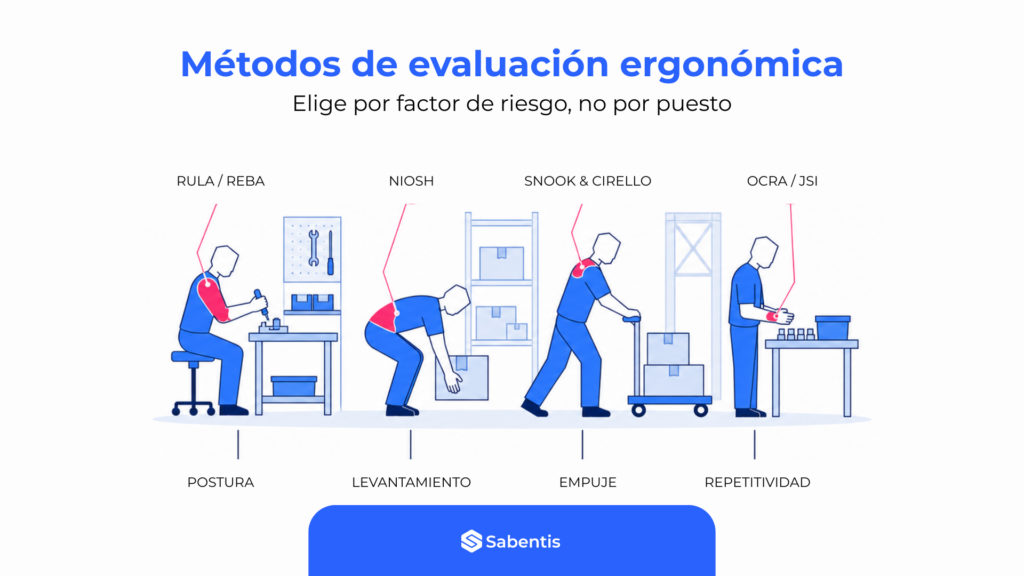
Which method should I use for a warehouse? That is the wrong question. A single warehouse involves lifting, which calls for the NIOSH equation. It also involves cart pushing, which asks for the Snook and Ciriello tables, and awkward postures, which call for REBA or OWAS. In other words, the workstation does not decide. The risk factor decides.
That rule shapes the rest of this guide on ergonomic assessment methods, and it also shapes the map below.
Map of ergonomic assessment methods by risk factor
| Risk factor | Reference ergonomic assessment methods | Related standard or rule |
|---|---|---|
| Postural load | RULA, REBA, OWAS | No standard of its own |
| Lifting of loads | NIOSH equation, INSST Technical Guide | ISO 11228-1, RD 487/1997 |
| Pushing, pulling and carrying | Snook and Ciriello tables | ISO 11228-2 |
| Repeated movements | OCRA Checklist, JSI (Job Strain Index) | ISO 11228-3, EN 1005-5 |
| Patient handling | MAPO | Health and care sector |
| Office and remote work | ROSA | Display screen work |
| Physical load and energy use | Metabolic rate | ISO 8996 |
| Workstation design | Body size percentiles | No standard of its own |
The map sums up the logic behind all the ergonomic assessment methods explained below. Each block states what the method measures, when to use it and which standard backs it.
Postural load: RULA, REBA and OWAS
The RULA method (Rapid Upper Limb Assessment, McAtamney and Corlett, 1993) measures the postural load of the upper limb, the neck and the trunk. It returns an action level from 1 to 4. It is quick, although it only suits fixed postures and not moving runs.
The REBA method (Rapid Entire Body Assessment, Hignett and McAtamney, 2000) widens the analysis to the whole body. It also accepts dynamic, unstable and loaded postures, with a score from 1 to 15. The rule is easy to remember: if the task sits at a bench or a screen, use RULA; if the whole body takes part and there is handling, use REBA.
OWAS (Ovako Working Posture Analysing System) works with sampling over time. Instead of scoring a single posture, it looks at how back, arm and leg postures spread across the shift. Then it groups them into four action categories.
Manual handling of loads: NIOSH, Snook and Ciriello and the INSST guide
The NIOSH equation (Waters, Putz-Anderson, Garg and Fine, 1993) works out the recommended weight limit (RWL) of a lift from seven factors. Then it compares that limit with the real weight through the lifting index (LI). When the LI goes above 1, the risk grows. ISO 11228-1:2021 includes this equation inside its assessment framework.
Pushing, pulling and carrying get far less attention than they deserve. For those tasks the reference is the Snook and Ciriello tables (Liberty Mutual), which fit inside the scope of ISO 11228-2.
In Spain, moreover, the INSST Technical Guide develops RD 487/1997 and sets out the official steps for manual handling of loads, with a tolerable or not tolerable result. Among all the ergonomic assessment methods, this is the one the labour authority expects to see in a Spanish report.
Repeated movements: OCRA and JSI
The OCRA Checklist (Occhipinti and Colombini) is the method that ISO 11228-3 and EN 1005-5 quote for repeated work. It combines frequency, force, posture, recovery and other factors. The 2026 review of ISO 11228-3 updates that framework, so check which edition your assessment follows.
The JSI (Job Strain Index, Moore and Garg) focuses on the hand, the wrist and the forearm. Problems such as tendinitis or carpal tunnel syndrome show up there. The ergonomics section of Prevencion Integral carries technical articles and cases on this kind of risk.
Specific contexts: MAPO in healthcare and ROSA in the office
The MAPO method (Movimentazione e Assistenza di Pazienti Ospedalizzati) is the standard for patient handling in hospitals and care homes. Here the load is a person, so general ergonomic assessment methods do not fit. Good ergonomics management in health care needs a tool of its own.
ROSA (Rapid Office Strain Assessment) looks at the screen workstation: chair, monitor, keyboard, mouse and telephone. It has become the natural pick for the office and for remote work.
Rules behind the ergonomic assessment methods
The ISO 11228 series covers lifting and carrying (part 1), pushing and pulling (part 2) and repeated movements (part 3). EN 1005-5 completes it in the machinery field. In Spain, RD 487/1997 rules manual handling of loads, and Ley 31/1995 asks firms to assess every risk, ergonomic ones included. Finally, ISO 8996 gives the metabolic rate figures behind the ergonomic assessment methods for physical load.
Ergonomic assessment methods on video
All observation methods share two weak points. They eat up work hours, and they lean on the eye of the assessor. Today there are two ways to narrow that margin. On one hand, computer vision systems read joint angles from a video and score RULA, REBA or MAPO on their own. On the other hand, sensors on the body measure movement instead of guessing it.
At Sabentis that approach already works. The AI posture analysis inside the Ergonomics module scores well known ergonomic assessment methods from a video shot on a phone. The International ORP Foundation follows these advances closely in its publications and congresses.
Here is a short recap before the answers below. Pick the risk factor first. Then pick the tool that measures it. Read the score as a guide and not as a verdict. Write down the date, the task and the name of the person who ran the study. That way the next review starts from solid ground and you can see if the change worked.
Frequently asked questions about ergonomic assessment methods
Which is the best ergonomic assessment method?
None of them wins in the abstract, because each one measures a different risk factor. The useful question is another one: which factor weighs most in the task. From there, the map in this guide shows the way.
When should you use RULA and when REBA?
Use RULA if the risk sits in the arm and the task stays static or anchored to the workstation. Use REBA if the whole body takes part, if postures turn dynamic or if the worker handles loads.
Which method does Spanish law require?
The law asks employers to assess the risk, although it does not impose a single method. For manual handling of loads, the INSST Technical Guide that develops RD 487/1997 is the one the labour authority takes by default.
Can ergonomic assessment methods be automated?
Yes. Computer vision and sensors can score watch based methods from a video or from a direct reading. This cuts assessment time, and it also cuts the gap in judgement between experts.
From data to risk management
Assessment is only the first step. Afterwards you have to manage what the assessment brings to light: rank the measures, follow them up and prove the gains with data. If you want to see how these ergonomic assessment methods work together, with AI posture analysis included, request a Sabentis demo.
Still running your ergonomic assessment methods on spreadsheets?
Sabentis brings RULA, REBA, NIOSH, OCRA and MAPO into one tool. The scores, the risk levels and the reports come out ready.
Request your demoA guided 30 minute demo. No strings attached.